Payment Reminder Messages on WhatsApp: Templates and Rules
Payment reminder message samples for WhatsApp (invoices, fees, subscriptions, renewals), how Meta categorises them as utility or marketing, what WhatsApp’s policy forbids, when to send them and how to automate reminders in India.
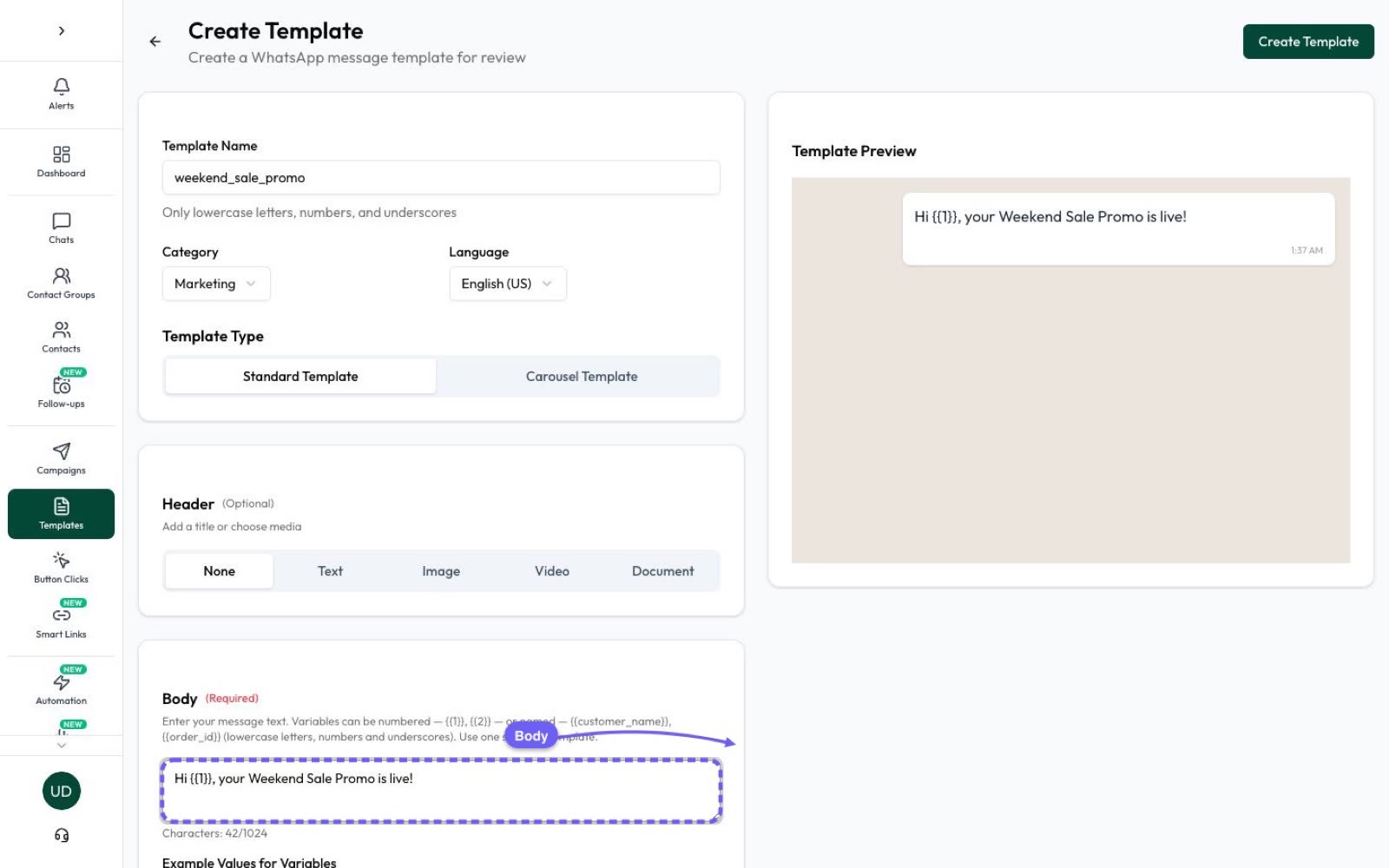
A WhatsApp payment reminder is usually a utility template: a non-promotional message about a payment the customer already owes or has agreed to, such as an invoice, a fee or a subscription charge. Meta’s own example of a utility template is “Reminder: Your monthly payment for {{service}} will be billed on {{date}}”.
Add an offer (“renew today and save 10%”) and the same reminder becomes marketing, which costs more and is limited per person. This guide gives ready-to-adapt payment reminder samples, explains the category rules, the policy lines you must not cross, and how to schedule reminders automatically.
Key takeaways
- Plain reminders about an existing payment are utility; anything that promotes, upsells or pushes a renewal with an offer is marketing.
- Meta recategorises templates: a “utility” template it judges to be marketing is approved as marketing.
- Never ask for full card numbers or other sensitive financial or ID numbers in chat. WhatsApp’s policy forbids it.
- WhatsApp lists debt collection among restricted services; check your use case before sending collection messages.
- Use a URL button with your payment link, a clear amount and due date, and an easy way to reach a person.
Utility or marketing? How Meta decides
Meta’s template categorisation guidelines say utility templates are “typically triggered by a user action or request” and must not “promote, recommend, upsell, or cross-sell products; include offers; or attempt to secure renewals”. If a template mixes utility and marketing content, or it’s unclear, it’s treated as marketing.
| Reminder | Likely category | Why |
|---|---|---|
| “Invoice INV-2041 for ₹12,500 is due on 30 October.” | Utility | About a payment the customer already owes |
| “Your monthly plan of ₹499 will be charged on 5 November.” | Utility | Matches Meta’s own utility example |
| “Fee for November is due on the 10th.” | Utility | An agreed, recurring payment |
| “Your subscription expires on 30 Oct. Renew today and save 15%!” | Marketing | An offer to secure a renewal |
| “Pay now and get a free gift” | Marketing | Promotional |
Payment reminder message samples
Sample templates with placeholders in {{ }}. Adapt the wording to your business and keep it factual.
Invoice due
- “Hi {{name}}, invoice {{invoice_no}} for ₹{{amount}} from Example Traders is due on {{due_date}}. Tap below to view and pay. Already paid? Please ignore this message.” [Pay now] [Talk to us]
Invoice overdue (polite follow-up)
- “Hi {{name}}, our records show invoice {{invoice_no}} for ₹{{amount}} was due on {{due_date}}. If you’ve already paid, thank you, and please share the reference so we can update our records.” [Pay now] [Share reference]
School or coaching fees
- “Dear parent, the {{month}} fee of ₹{{amount}} for {{student}} at Example Academy is due on {{due_date}}. You can pay online or at the office.” [Pay online]
Subscription or plan charge
- “Hi {{name}}, your {{plan}} plan (₹{{amount}}/month) will be charged on {{date}} to the card ending {{last4}}. Manage your plan anytime.” [Manage plan]
Rent or maintenance
- “Hi {{name}}, the maintenance charge of ₹{{amount}} for flat {{flat}} is due on {{due_date}}. Reply HELP if you have a question.”
More fee reminders for schools and coaching classes are in WhatsApp messages for tuition classes, and general rules for writing templates in WhatsApp template messages.
What WhatsApp’s policy says about payments
- No sensitive numbers. The Business Messaging Policy says not to ask people to share full-length payment card numbers, financial account numbers, ID card numbers and similar identifiers. Showing the last four digits of a card is a common, safer way to identify it.
- Debt collection is restricted. WhatsApp lists payday loans, peer-to-peer lending and debt collection among goods and services it can’t be used to promote or facilitate. A shop reminding its own customer about an invoice is a normal transactional message; a collection agency chasing third-party debt is a different case. If you’re a lender or collector, check the policy with your legal team first.
- Opt-in still applies. Customers must have agreed to receive messages from you. See WhatsApp opt-in.
- Give a way to a person. Automated chats need a clear way to reach a human, which matters most when money is involved.
When and how often to send reminders
| Timing | Message | Tone |
|---|---|---|
| 3 to 5 days before | Upcoming due date with amount and link | Friendly heads-up |
| On the due date | Due today, with the payment link | Clear and short |
| 2 to 3 days after | Overdue follow-up, “if already paid, ignore” | Polite, no threats |
| After that | A call or a personal message from your team | Human |
Send during working hours, stop reminders as soon as the payment is received, and don’t send more than one reminder a day. People who feel spammed block businesses, and blocks lower your quality rating.
What a payment reminder costs in India
A utility template to an Indian number costs ₹0.1150 at Meta’s list rate from 1 October 2026, plus 18% GST and your provider’s margin; utility messages sent inside an open 24-hour window are charged too since that date. A marketing template costs much more, so keeping reminders genuinely transactional saves money. Details in WhatsApp API pricing in India, and Automate AI’s own rates on our pricing page.
Automating payment reminders with Automate AI
- From your billing system: send the reminder template through the REST API when an invoice is created or becomes due, with the amount, date and payment link filled in.
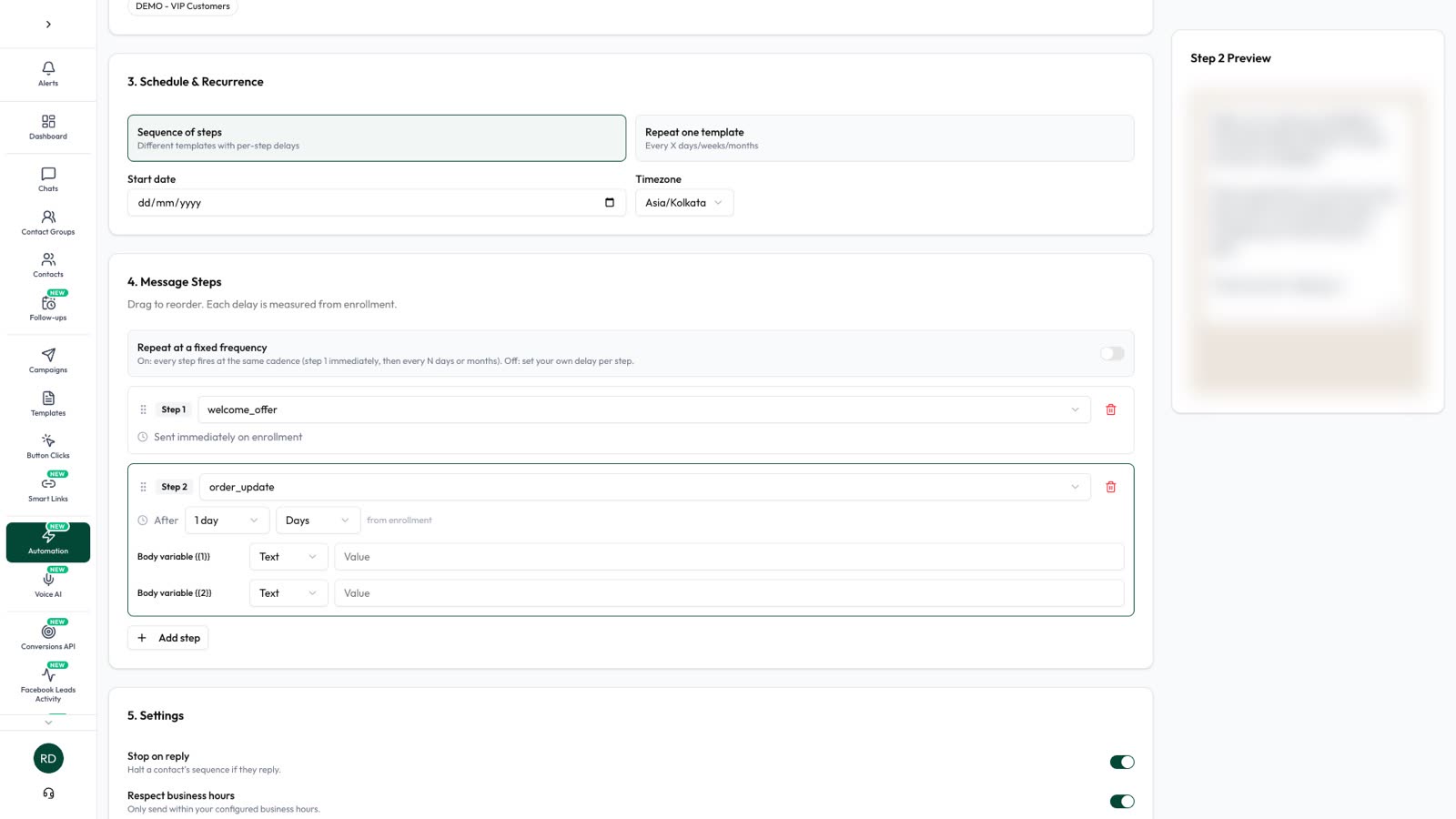
- Monthly fees: a scheduled automation sends a template to a contact group on a set day each month, such as fees due on the 10th.
- Yearly renewals: store a renewal date on each contact and send the reminder a set number of days before it every year, for insurance, AMC or membership renewals.
- Payment link per customer: a URL button with a variable at the end gives each customer their own link.
- Replies go to your team: questions land in the shared inbox, and a chatbot can answer common ones such as “where do I pay?”.
Frequently asked questions
Is a payment reminder a utility or marketing message on WhatsApp?
A plain reminder about a payment the customer already owes or agreed to is utility; Meta’s own utility example is a monthly payment reminder. If it includes an offer, discount or push to renew, Meta treats it as marketing.
Can I send payment reminders to customers who haven’t messaged me?
Yes, as an approved template to customers who opted in to messages from your business.
Can I ask customers for card details on WhatsApp?
No. WhatsApp’s policy says not to ask people to share full card numbers, bank account numbers or ID numbers. Send a secure payment link instead.
Can I collect payments inside WhatsApp?
In India, Meta’s Payments API supports in-chat UPI and card payments through certain gateways. Automate AI doesn’t offer this; most businesses send a payment link in a template button.
How much does a WhatsApp payment reminder cost in India?
At Meta’s list rate from 1 October 2026, a utility template to an Indian number costs ₹0.1150 plus GST and your provider’s margin. Automate AI charges ₹0.19 on Series 1 to 3 and ₹0.15 on Series 4.
Sources
- Meta: Template categorization guidelines
- WhatsApp Business Messaging Policy
- Meta: Pricing on the WhatsApp Business Platform
- Meta: Payments API (India) overview
- Meta: Template components (URL buttons)
WhatsApp rules and prices change. We check these guides against Meta’s documentation, but always confirm current terms with Meta before you rely on them. Questions? Message us on WhatsApp at +91 836 977 8812.