WhatsApp vs SMS Marketing in India: Rules, Reach and Cost
WhatsApp vs SMS for businesses in India: TRAI’s DLT rules for SMS (headers, templates, -P/-S/-T suffixes, DND and the 10 AM–9 PM default), WhatsApp’s opt-in and template rules, what each costs, what customers see, and when to use which.
SMS reaches every phone; WhatsApp reaches people with a richer, two-way message. In India, promotional SMS runs through TRAI’s DLT system, with registered headers and templates, DND preferences and a default delivery window of 10 AM to 9 PM. WhatsApp marketing runs through Meta’s Business API, with approved templates, opt-in from each customer, images, buttons and replies in the same chat.
Neither is “better” for everything. This guide compares the rules, what customers see, how costs work and where each fits, so you can decide what goes on WhatsApp and what stays on SMS.
Key takeaways
- SMS: register your business, headers and content templates on DLT; promotional headers end in -P; links must be whitelisted.
- Promotional SMS reaches customers by default only between 10 AM and 9 PM and respects their DND choices.
- WhatsApp: customers must opt in to hear from your business; every template is approved by Meta.
- WhatsApp messages carry images, buttons, coupon codes and replies, with delivered and read reports.
- Use WhatsApp for offers, updates and conversations; keep SMS for people not on WhatsApp and as a fallback for critical alerts.
At a glance
| SMS (India) | WhatsApp Business API | |
|---|---|---|
| Who regulates it | TRAI (TCCCPR rules, DLT) | Meta’s policies, plus Indian law |
| Registration | Business, headers and templates on DLT | Meta business account, approved display name and templates |
| Consent | DND preferences; explicit consent for promotions to DND numbers | Opt-in to hear from your business |
| Sender shown | Header such as AB-EXMPLE-P | Your business name and profile |
| Format | Plain text (about 160 characters per part) | Text, image, video, document, buttons, lists |
| Replies | Usually not to promotional headers | Two-way chat in the same thread |
| Reports | Delivered | Sent, delivered, read, clicked, replied |
| Reach | Every mobile number | People who use WhatsApp |
The SMS rules in India (TRAI and DLT)
Commercial SMS in India is governed by TRAI’s Telecom Commercial Communications Customer Preference Regulations (TCCCPR), 2018 and runs on the telecom operators’ DLT (distributed ledger) platforms.
- Register first. Your business (the principal entity), every header (sender ID) and every content template must be registered on DLT. If you collect consent, the consent template is registered too. Since 2025, entity registration also needs physical verification.
- Three categories. Transactional messages respond to a transaction the customer just made, such as an OTP. Service messages go to your own customers about their product or service. Promotional messages advertise, and must carry an opt-out. Adding promotion to a service message makes the whole message promotional.
- Header suffixes. Headers carry a suffix showing the category: -P promotional, -S service, -T transactional and -G government.
- DND preferences. Customers can block promotions entirely or by category (banking, real estate, education, health and more) through 1909 or the TRAI DND app. Promotions with recorded explicit consent still reach them.
- Timing. By default, promotional SMS isn’t delivered between 9 PM and 10 AM.
- Links and numbers. Since 1 October 2024 SMS containing links, APK or app links that aren’t whitelisted on DLT are blocked, and variables in templates must now be tagged and validated.
- Consent withdrawal. If a customer withdraws consent, you can’t ask for it again for 90 days.
The WhatsApp rules
- Opt-in. WhatsApp’s Business Messaging Policy lets you message people who gave you their number and agreed to hear from your business. The opt-in can be collected on your website, in store, by SMS or on a call, as long as it names your business. See WhatsApp opt-in.
- Approved templates. Any message you start must be a template approved by Meta, in a category: marketing, utility or authentication. See WhatsApp template messages.
- 24-hour window. When a customer replies, you can chat freely for 24 hours. See the 24-hour window.
- Quality and limits. Blocks and reports lower your quality rating and can pause templates; Meta also limits how many marketing messages each person receives.
- Customer control. People can stop marketing messages from your business inside WhatsApp, and you must respect it.
What customers see
The same Diwali offer looks very different on each channel:
| SMS | |
|---|---|
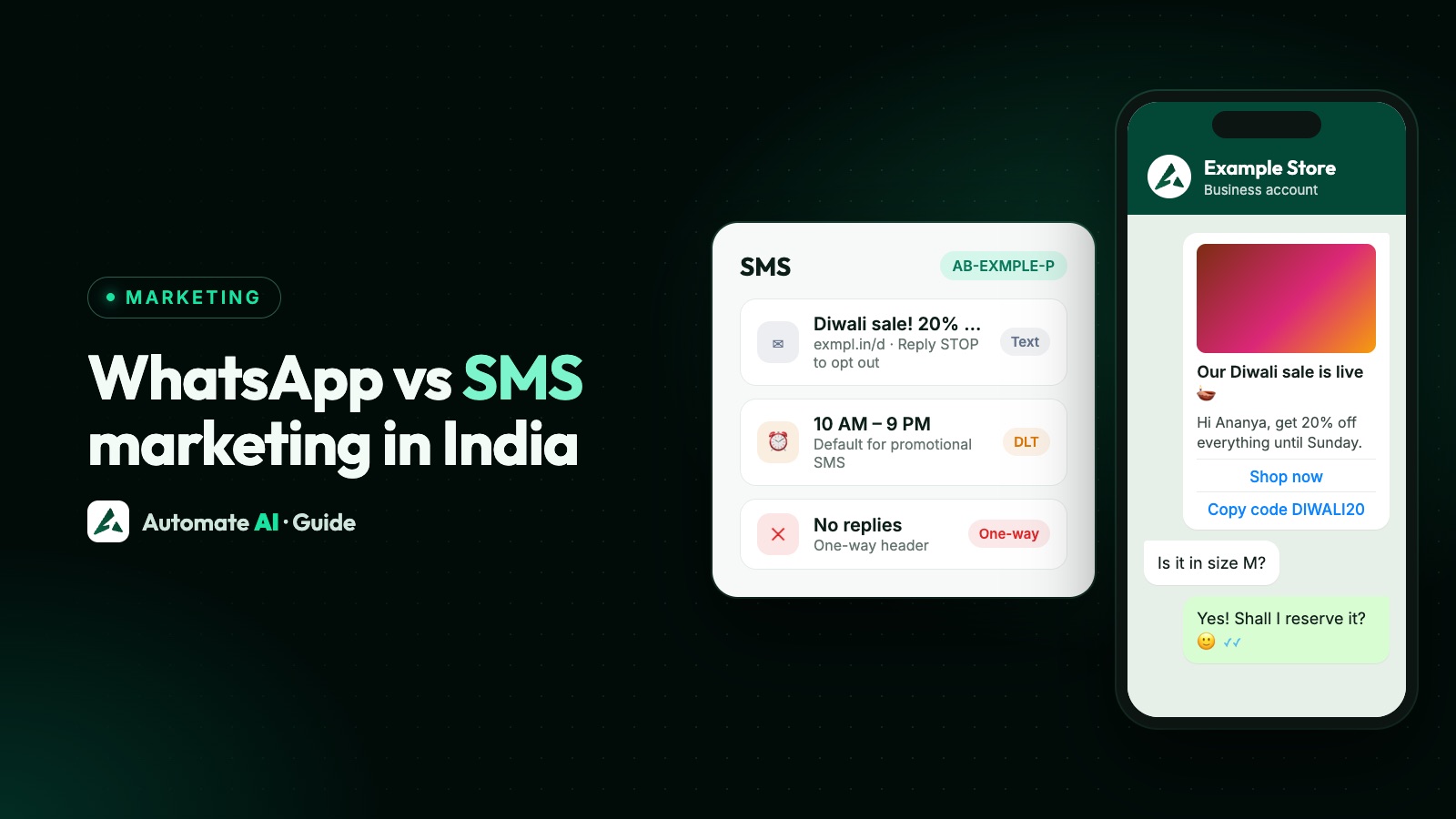
| From AB-EXMPLE-P: “Diwali sale! 20% off till Sun. Shop: exmpl.in/d Reply STOP to opt out” | From Example Store (with logo): festive image, “Hi Ananya, our Diwali sale is live…”, buttons “Shop now” and “Stop promotions”, and a copy-code button for the coupon |
| Customer can’t ask a question back | Customer replies “Is it in size M?” and gets an answer in the same chat |
There’s no official, independent figure comparing SMS and WhatsApp open rates in India, so be wary of round numbers quoted online. Test with your own customers: WhatsApp reports read and reply counts per campaign, which makes that easy.
Cost
SMS is usually cheaper per message, but long messages are split into several parts and links need setup on DLT. WhatsApp marketing templates cost more per message, with Meta’s India rate at about ₹0.86 per delivered marketing message plus your provider’s margin and GST, and utility templates cost far less. Replies from customers are free, and the first 1,000 service replies per number each month are free.
Compare on outcomes, not price per message: replies, orders and bookings per ₹1,000 spent. Rates for WhatsApp are in WhatsApp API pricing in India.
When to use which
| Message | Best channel |
|---|---|
| Offers and festive campaigns | WhatsApp (images, buttons, replies) |
| Order, delivery and appointment updates | WhatsApp utility templates, with SMS for customers not on WhatsApp |
| One-time passwords | Either; WhatsApp authentication templates with SMS as a fallback is common |
| Customer support | WhatsApp (two-way chat, shared inbox) |
| Critical alerts that must reach everyone | SMS, or both |
| People who haven’t opted in to WhatsApp | SMS (within DLT rules), and ask them to opt in |
Moving campaigns to WhatsApp with Automate AI
Automate AI runs your WhatsApp campaigns, templates, chatbots and shared inbox on Meta’s official API, with live delivered, read and replied counts. Series 2, 3 and 4 also include RCS, rich messages with images and cards for Android phones that support it, from the same campaigns. Keep your existing DLT-registered SMS provider for people who aren’t on WhatsApp. See WhatsApp campaigns and pricing.
Frequently asked questions
Is WhatsApp marketing better than SMS in India?
For offers, updates and conversations, WhatsApp usually works better because messages carry images and buttons and customers can reply. SMS still reaches every phone and suits critical alerts and people who don’t use WhatsApp.
Do I need DLT registration for WhatsApp messages?
No. DLT registration under TRAI’s rules is for commercial SMS and calls. WhatsApp business messaging follows Meta’s policies: a business account, approved templates and opt-in from customers.
What time can promotional SMS be sent in India?
By default, promotional SMS reaches customers only between 10 AM and 9 PM; the hours outside that are blocked unless the customer changes their preferences.
What do -P, -S and -T mean in SMS headers?
They show the message category: -P promotional, -S service, -T transactional, and -G government.
Can I send WhatsApp messages to DND numbers?
DND is a TRAI preference for SMS and calls. On WhatsApp, what matters is whether the customer opted in to hear from your business and hasn’t stopped your marketing messages.
Sources
- TRAI: TCCCPR 2018, consolidated text
- TRAI: Amendment regulations, 12 February 2025 (header suffixes)
- TRAI: Direction on whitelisting URLs and APK links (30 August 2024)
- Meta: Get opt-in for WhatsApp
- WhatsApp Business Messaging Policy
WhatsApp rules and prices change. We check these guides against Meta’s documentation, but always confirm current terms with Meta before you rely on them. Questions? Message us on WhatsApp at +91 836 977 8812.