Meta Ads for Law Firms: What’s Allowed and How to Get Enquiries
Meta ads for lawyers and law firms: check your regulator first, then Meta’s rules on wording, lead forms and special categories, sample ads and WhatsApp intake.
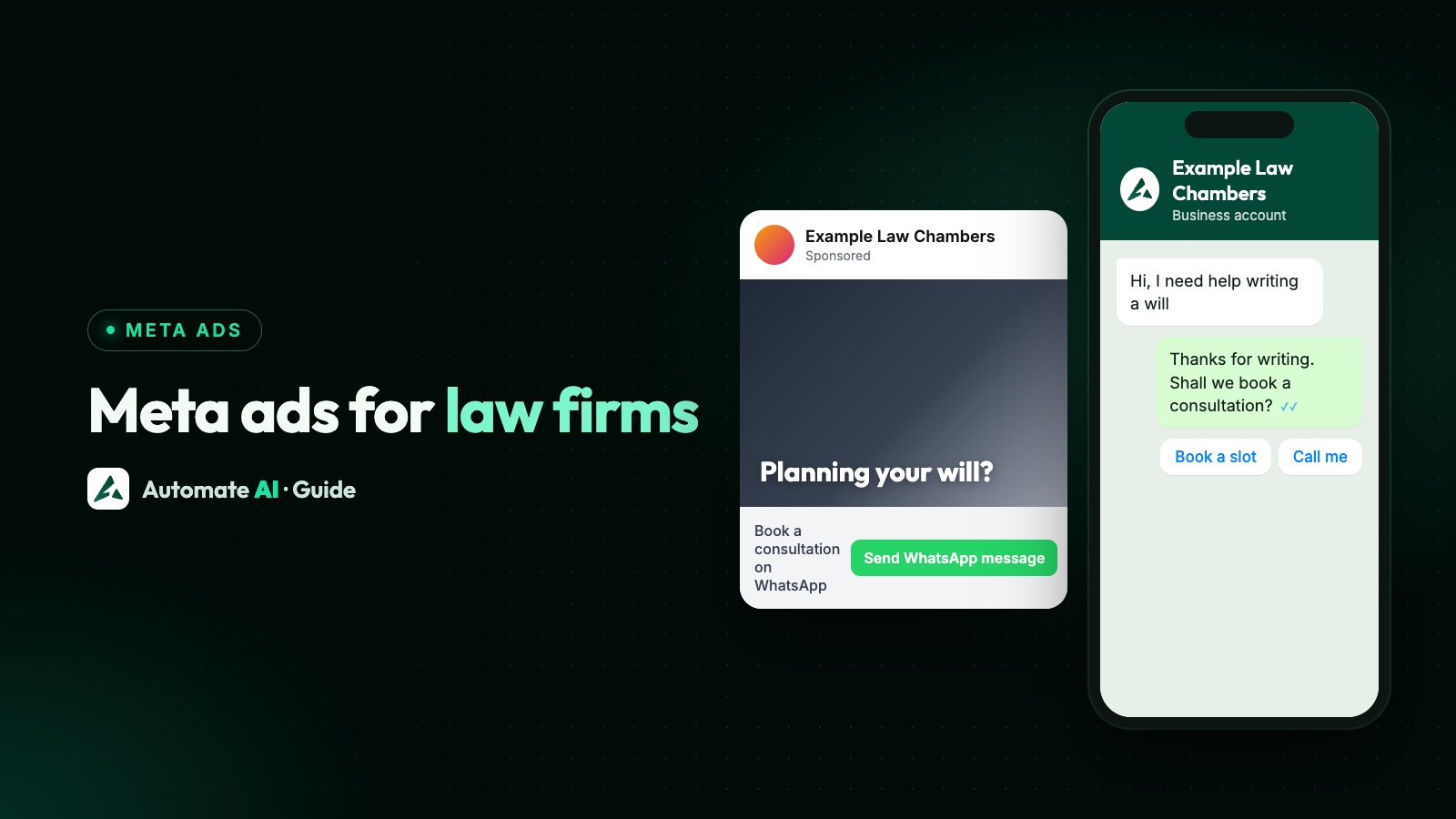
Meta lets law firms advertise on Facebook and Instagram, but your professional regulator decides first whether you may advertise at all, and what you may say. In India, for example, the Bar Council of India’s rules say an advocate shall not solicit work or advertise in any manner. Where advertising is allowed, the ads that tend to work are plain ones that offer a consultation and open a WhatsApp chat or a short form.
This guide covers what to check with your regulator, Meta’s rules that catch legal ads (wording, lead form questions, special categories), sample ads and how to handle the enquiries. It isn’t legal advice, and rules on lawyers’ advertising differ by country and change, so confirm with your own bar council, law society or regulator. How to run WhatsApp inside a practice (intake bots, reminders, confidentiality) is in WhatsApp for lawyers.
Key takeaways
- Check your regulator before spending anything. The Bar Council of India’s rules bar advocates from advertising; England and Wales’ SRA requires publicity to be accurate and not misleading.
- Meta’s Advertising Standards have no separate policy for legal services that we found; the general rules apply, and Meta says advertisers must follow local laws and self-regulatory codes.
- Don’t imply you know the viewer’s situation: Meta’s own example of a banned line is “Are you a convicted felon?”
- Lead forms can’t ask about criminal or arrest history, debts, income, insurance policies or health.
- Debt recovery and debt relief ads can fall under financial products and services; ads that argue about immigration or crime policy can be social issue ads.
- Open a WhatsApp chat to book a consultation, and keep case details out of the chat.
Step one: can you advertise at all?
Meta will review your ad against its own policies, not your professional rules. Its Advertising Standards say it’s the advertiser’s responsibility to comply with all local laws, regulations and, where applicable, self-regulatory advertising codes. For lawyers, those professional rules usually matter more than Meta’s.
Two examples we checked on the regulators’ own websites:
| Where | Regulator | What its rules say about advertising |
|---|---|---|
| India | Bar Council of India | An advocate shall not solicit work or advertise in any manner, including by circulars, advertisements or touts. Sign-boards and stationery shouldn’t say the advocate specialises in a particular type of work. |
| England and Wales | Solicitors Regulation Authority (SRA) | Publicity about your practice must be accurate and not misleading, including about charges. No unsolicited approaches to members of the public to advertise your services, except current or former clients. |
| Everywhere else | Your bar council, law society or regulator | Check before you advertise. Rules often differ on advertising itself, claims of specialisation, testimonials, fee statements and required wording. |
Questions worth asking your regulator: may I run paid social ads? May I describe areas of practice or call myself a specialist? May I quote fees or offer a free first consultation? May I use client reviews? Does an ad need my registration details or any set wording?
Meta’s wording rules that catch legal ads
We looked through the list of Meta’s Advertising Standards and found no policy written for legal services, so the general rules apply. These are the ones law firms run into most:
Don’t imply you know the viewer’s situation
Meta’s privacy violations and personal attributes policy says ads must not assert or imply personal attributes, and lists among them criminal record, vulnerable financial status, physical or mental health, religion and others. Meta’s own examples are useful for lawyers: “Services to clean up any previous offences” is allowed, “Are you a convicted felon?” isn’t, and “Are you bankrupt? Take a look at our services” isn’t either.
| Risky (implies the viewer’s situation) | Better (describes your service) |
|---|---|
| “Arrested last night? Call us now.” | “Criminal defence consultations, same week.” |
| “Drowning in debt? We can help you.” | “Advice on debt recovery claims for small businesses.” |
| “Is your marriage over?” | “Family law: divorce, custody and separation agreements.” |
| “Injured at work? You deserve compensation.” | “Workplace injury claims: book a first consultation.” |
The last row is our reading of the health part of the rule: a line that assumes the viewer was injured implies a physical condition.
No promises or borrowed endorsements
Meta’s prohibited commercial practices policy names deceptive pricing and unauthorised endorsements. So a “free consultation” must be free, and you shouldn’t imply a court, government body or well-known person endorses you. Don’t promise outcomes or case values; many regulators restrict that too.
Special ad categories and social issue ads by practice area
Most legal ads are ordinary ads. A few practice areas touch Meta’s special categories:
| If your ad is about | Meta category to consider | What it means |
|---|---|---|
| Debt recovery, debt consolidation or debt relief services | Financial products and services | Meta lists debt recovery and debt relief among credit ads in the US, Canada and certain parts of Europe; targeting is limited (no age, gender or postcode targeting, lookalikes or saved audiences) |
| Hiring lawyers, paralegals or interns | Employment | Job and internship ads are employment ads, with the same limited targeting |
| Arguing for or against immigration, crime or civil rights policy | Social issues, elections or politics | Meta lists immigration, crime and civil and social rights as social issues in countries including India, the UK and the US; such ads may need authorisation and a “Paid for by” disclaimer, and Meta doesn’t allow them in the EU |
| Booking a consultation for family, property, company or criminal law | Usually none | An ordinary ad, with normal targeting |
Meta says the financial category is required for financial products and services ads from US advertisers or reaching US audiences, and that its examples aren’t comprehensive and aren’t legal advice. Social issue ads are those that seek to influence public opinion through discussion, debate or advocacy; an ad that simply offers immigration consultations is different from one campaigning about immigration law, but if your ad takes a position, choose the category.
Lead form questions you can’t ask
Lead forms are useful for firms that call every enquiry back, but Meta’s list of prohibited instant form questions hits legal intake hard. You must not ask for:
- Criminal or arrest history.
- Financial information, including income, credit score, bank account numbers, bankruptcy status and debt status.
- Insurance information, such as the insurer’s name or policy numbers, which matters for injury and claims work.
- Health information, including physical or mental conditions and medical treatments.
- Government-issued ID numbers, such as passport or driving licence numbers.
- Religious beliefs, race, sexual orientation or trade union membership.
If a form includes a prohibited question, Meta says the ad won’t run. What you can ask instead:
- Area of law, as a choice: family, property, employment, company, criminal, other.
- City or region, using Meta’s prefilled City question.
- Preferred way and time to be contacted, as a choice.
- Opt-in wording, such as “Example Law Chambers will contact you on WhatsApp to arrange a consultation.” Add it in Ads Manager’s form editor.
Avoid a free-text “describe your case” box. People will type sensitive details, and the facts belong in the consultation.
Sample ads for law firms
Made-up examples for sample firms in places where advertising is allowed. Each describes a service and one next step. Check every line against your own regulator’s rules before using anything like it.
| Firm | Headline | Greeting | Pre-filled message |
|---|---|---|---|
| Example Family Law | Family law consultations this week | Thank you for contacting Example Family Law. Please don’t send case details or documents here. Would you like a call or an office visit? | Hi, I’d like to book a family law consultation |
| Example Business Lawyers | Contracts and company law for small firms | Hi! Which area is it: contracts, company set-up or a dispute? | Hi, I’d like help with a business matter |
| Example Wills & Probate | Wills and probate: book a first meeting | Hi! Is it about making a will or dealing with an estate? | Hi, I’d like to book a meeting about a will |
| Example Employment Law | Employment law advice for employees | Hi! We’ll arrange a short first call. What day suits you? | Hi, I’d like to speak to an employment lawyer |
Each greeting asks one question and, for sensitive areas, asks people not to send details in the chat. In Automate AI, the greeting can be up to 300 characters and the pre-filled message up to 120. If an ad promotes legal work linked to buying or renting homes and you advertise in or to the US, Canada or Europe, check whether Meta’s housing category applies, since its housing definition includes related services.
Location: if you serve one jurisdiction, turn off Reach more people likely to respond in Ads Manager. Meta’s help page names law among professional services where that setting finds people interested in your service who may not live or travel in the places you chose, which you don’t want if you can only act locally.
Handling enquiries from the ad
An ad enquiry is a stranger with a problem. A few habits protect both of you:
- Reply fast, but only to book. Ask the area of law, city and a preferred time, and say advice is given in the consultation. The intake chatbot in WhatsApp for lawyers does exactly this.
- Run your conflict check before discussing anything about the matter, using the names you collect.
- Keep documents out of the chat. WhatsApp’s Business Messaging Policy says not to ask people to share ID card numbers, full card numbers or financial account numbers (we checked this for our lawyers guide). Use your secure upload route.
- Limit who reads ad chats in the shared inbox, for example the front desk and the lawyer assigned.
When someone messages you from a Click-to-WhatsApp ad in the WhatsApp Android or iOS app and you reply within the 24-hour window, Meta doesn’t charge for your messages in a free entry point window that can stay open for up to 7 days. Automate AI still charges its normal rates. Form leads need an approved template first; with Facebook Leads (AI + Automation Plan and Series 4), each lead gets it straight away. A sample utility-style first message: “Hi {{1}}, thank you for contacting Example Law Chambers. Reply with a day and time that suits you and we’ll confirm a consultation.” Meta decides the final category.
Run law firm ads from Automate AI’s Meta Ads menu
If your rules allow it, you can make these ads in Ads Manager or from Meta Ads in Automate AI’s main menu, on every plan, for account owners and managers. Meta bills the ad spend to your own ad account.
- Connect your ad account with Continue with Facebook and pick the firm’s Page. Chat ads open a chat with your connected WhatsApp number.
- Choose WhatsApp chats or Lead form, and describe the service in a line, such as “family law consultations at our city office”. AI drafts the ad with your own AI key added in Settings; check every word against your regulator’s rules, or write it yourself.
- Answer “Is this ad about any of these?” honestly: Jobs, Housing or property, Loans, credit or insurance, or Politics or social issues. With one chosen, the app applies Meta’s limits: ages 18 to 65+ and all genders, at least 25 km around a place, and no PIN codes, interests, behaviours or lookalikes. Don’t leave out any places either: Meta doesn’t allow location exclusions for these ads. Social issue ads also need Meta’s authorisation, done with Meta.
- Set your area, add a photo of your office or team, set a budget and publish. Nothing is spent until you publish, and Meta reviews the ad first.
Ads made here reach people 18 and over. Count consultations booked and matters opened, not chats: tag each ad in Settings › Lead Sources and see track which ads bring WhatsApp customers. If an ad is rejected, see Click-to-WhatsApp ad rejected, and for more on the builder, our Meta ads hub.
Frequently asked questions
Can lawyers advertise on Facebook and Instagram?
Meta allows legal services ads under its general Advertising Standards, but your professional rules come first. The Bar Council of India’s rules say advocates shall not advertise or solicit work in any manner; the SRA in England and Wales allows publicity that is accurate and not misleading. Check your own regulator. This isn’t legal advice.
Does Meta have a special policy for law firm ads?
We didn’t find one in Meta’s Advertising Standards. The general rules apply, especially personal attributes (don’t imply a criminal record, debts or health conditions), deceptive pricing and unauthorised endorsements, and Meta expects you to follow local laws and self-regulatory codes.
Can a lead form ask about someone’s criminal record or debts?
No. Meta prohibits instant form questions about criminal or arrest history and financial information, including income, bankruptcy status and debt status. Ask the area of law, city and preferred contact time instead.
Do debt or immigration lawyer ads need a special ad category?
They can. Meta lists debt recovery and debt relief among credit ads in the US, Canada and parts of Europe. Ads arguing about immigration or crime policy can be social issue ads needing authorisation. A plain consultation ad usually needs no category.
What should a law firm ad say?
The service, who it’s for, where you practise and one next step, such as booking a consultation, in words your regulator allows. Avoid questions about the viewer’s situation and any promise of outcomes.
Should enquiries go to WhatsApp or a form?
WhatsApp suits people who want to ask a quick question and book; a form suits firms that call every lead back. Either way, keep case details and documents out of both and move them to the consultation.
Sources
- Bar Council of India: BCI Rules (not advertise or solicit work)
- Solicitors Regulation Authority: Code of Conduct for Solicitors (8.8 and 8.9)
- Meta Advertising Standards: Introduction
- Meta Advertising Standards: Privacy violations and personal attributes
- Meta Advertising Standards: Prohibited commercial practices
- Meta Business Help Centre: Questions prohibited on your instant form
- Meta Business Help Centre: About ads for housing, employment or financial products and services
- Meta Business Help Centre: About social issues
WhatsApp rules and prices change. We check these guides against Meta’s documentation, but always confirm current terms with Meta before you rely on them. Questions? Message us on WhatsApp at +91 836 977 8812.