WhatsApp vs Telegram for Business: Which Should You Use?
WhatsApp vs Telegram for business, compared: business accounts, bots, channels and groups, API costs, opt-in rules, verification, payments and which to use.
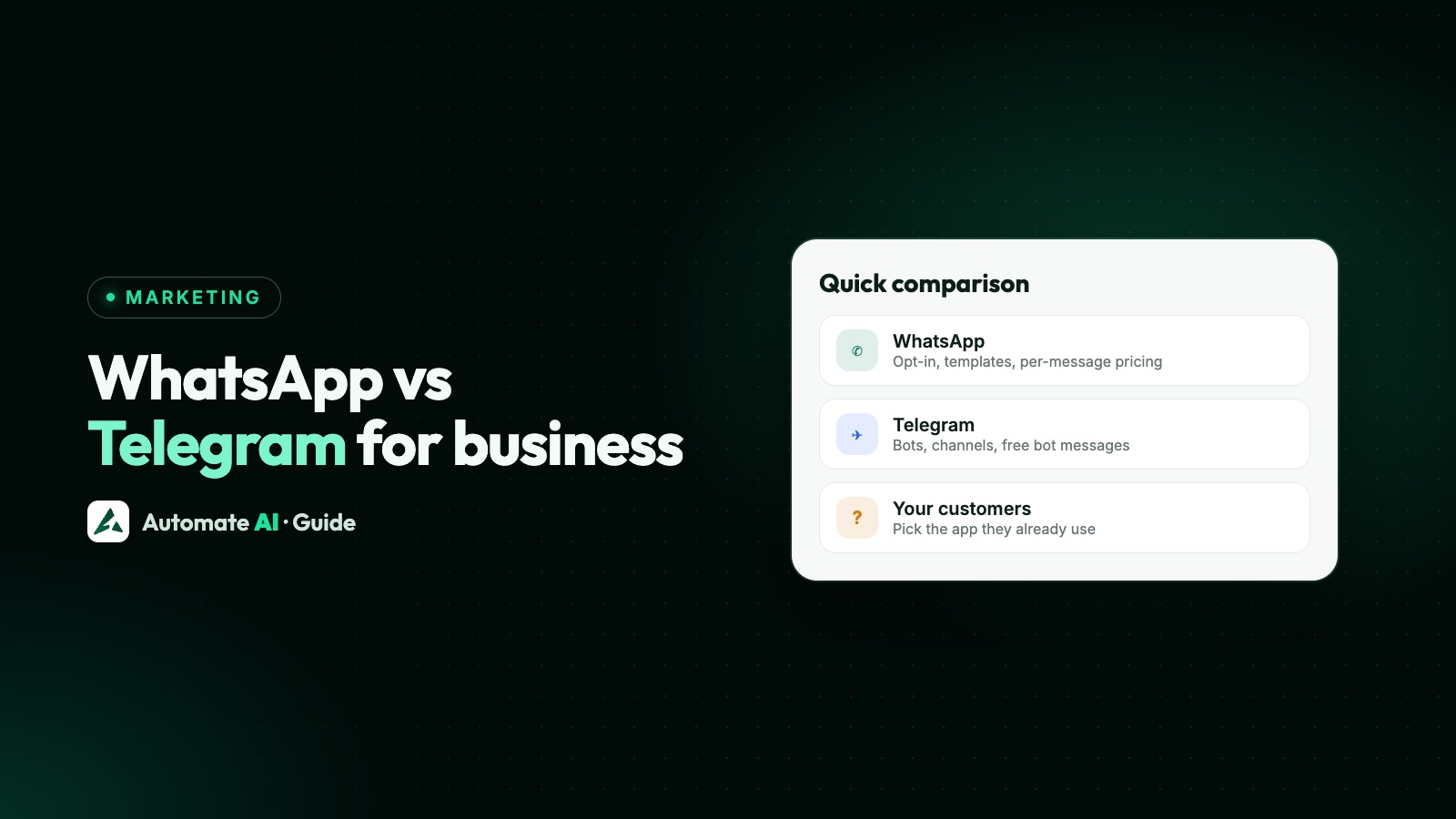
Use WhatsApp when you need to reach your own customers one to one, and Telegram when you want to build a public audience that comes to you. WhatsApp’s Business Platform lets you message people first with approved templates, once they’ve opted in, and charges per delivered message. Telegram’s Bot API is free, but a bot can’t start a conversation: people have to open your bot or join your channel first.
That one difference shapes almost everything else: how you collect contacts, how you broadcast, what it costs and which rules apply. This guide compares the two feature by feature, using only what each company documents, and ends with a simple way to decide.
Key takeaways
- WhatsApp lets a business message opted-in customers first with approved templates; Telegram bots can’t start conversations.
- Telegram’s Bot API is free; WhatsApp’s API is charged per delivered message, by category and country.
- For one-to-many updates, both have channels with no follower limit; Telegram groups go up to 200,000 members, WhatsApp groups to 1,024.
- Both ban spam. WhatsApp requires opt-in that names your business; Telegram’s bot terms forbid unsolicited messages.
- Many businesses use WhatsApp for customers and Telegram for a community or content channel. Automate AI is built for WhatsApp and doesn’t connect to Telegram.
WhatsApp vs Telegram for business at a glance
Here are the two side by side. WhatsApp facts come from Meta’s and WhatsApp’s pages, Telegram facts from telegram.org and core.telegram.org.
| Telegram | ||
|---|---|---|
| Business account | Free WhatsApp Business app, or the WhatsApp Business Platform (API) through a provider | Telegram Business features on your own account, which come with a Telegram Premium subscription |
| Can you message a customer first? | Yes, with an approved template, after they’ve opted in | Not with a bot. Bots can’t start conversations |
| Automation | Chatbots on the API, through a platform | Bots built on the free Bot API; bots can also answer for a Telegram Business account |
| One-to-many | Channels (one-way), groups up to 1,024, broadcast lists of up to 256, API campaigns | Channels with unlimited subscribers (owners can turn on direct messages), groups up to 200,000, bot broadcasts |
| Cost of messaging | Per delivered message on the API, by category and country; Business app messages are free | Bot API is free; paid broadcasts above about 30 messages a second |
| Consent rules | Opt-in that names your business, plus WhatsApp’s Business Messaging Policy | Bot Developer Terms ban unsolicited messages and spam |
| Verification | Official Business Account (blue tick) on the API, or Meta Verified on the app | Telegram verifies notable channels, groups and bots; user accounts can’t be verified |
| Payments in chat | Payments API in India through supported gateways | Payments API through third-party providers; digital goods use Telegram Stars |
On reach, each company publishes its own figure: WhatsApp says more than 3 billion people in over 180 countries use it, and Telegram’s FAQ says it has over 1 billion active users. What matters more is which app your customers already use, so ask them.
Business accounts and profiles
On WhatsApp there are two routes. The WhatsApp Business app is free on Android and iPhone and suits a small shop run from one phone. The WhatsApp Business Platform (API) is for teams, campaigns and automation, and runs through a provider. Our guide to WhatsApp vs WhatsApp Business explains the split.
On Telegram, you don’t create a separate business account. Telegram Business, launched in March 2024, turns your existing account into a business one. According to Telegram, it adds:
- Opening hours and a location on your profile.
- A start page for people who open an empty chat with you.
- Quick replies, greeting messages and away messages.
- Chat links that open a chat with a pre-filled message, for your website or a QR code.
- A connected bot that can answer chats you choose.
Bots and automation
Both apps support bots, but they work differently.
Telegram bots
- You create a bot with @BotFather, which gives you a token. Your own server runs the logic and talks to the free Bot API.
- A bot isn’t tied to a phone number, and people find it by its username or a t.me link.
- Bots can’t start conversations. A person must message the bot or add it to a group first.
- In groups, bots run in privacy mode by default and see only messages meant for them.
WhatsApp chatbots
- A chatbot runs on your business number through the API, usually built in a platform rather than coded from scratch.
- Once a customer messages you, a 24-hour customer service window opens and the bot can reply freely. Outside it, you can only send approved templates. See the 24-hour window.
- The free Business app has quick replies and greeting and away messages, but no chatbot builder.
In Automate AI you build WhatsApp chatbots with no code in the chatbot builder at Automation › Flows, included in Series 2, 3 and 4.
Broadcasting: channels, groups and lists
This is where people most often compare the two, and the tools don’t line up one to one.
| Tool | Telegram | |
|---|---|---|
| Channels | One-way, unlimited followers, numbers hidden; followers react and vote | Broadcast, unlimited subscribers; owners can turn on direct messages |
| Groups | Up to 1,024 members | Up to 200,000 members |
| Lists | Broadcast lists (WhatsApp and the Business app): up to 256 contacts each, delivered only to people who saved your number; a monthly broadcast limit applies in some countries | No equivalent; bots broadcast to people who started them |
| Personal campaigns | API templates to opted-in customers, with names, buttons and reports | Bot messages to users who started the bot |
Telegram’s bot FAQ says bots can message their users at no cost but can broadcast only about 30 messages a second. Bots with at least 100,000 Stars and 100,000 monthly active users can turn on paid broadcasts for up to 1,000 a second, at 0.1 Stars for each message above the free rate.
On WhatsApp, a channel is good for news, while an API campaign reaches each opted-in customer in a private chat. More in WhatsApp channels vs communities vs groups.
API access and what it costs
Telegram: Telegram describes its bot platform as free for users and developers. You pay for your own server and development, and for paid broadcasts if you need speed above the free limit.
WhatsApp: Meta charges per delivered message that a business sends, based on the template category (marketing, utility or authentication) and the recipient’s country code. Messages customers send you are free. Free-form replies inside the 24-hour window are free up to 1,000 per business number each month, and charged after that from 1 October 2026. Your provider’s plan is on top.
Rates by country are in our WhatsApp API pricing guide. Automate AI plans are on the pricing page.
Opt-in, spam and marketing rules
Both apps punish unwanted messages, in different ways.
- WhatsApp: Meta says you may message someone only if they gave you their number and opted in. The opt-in must say they’re agreeing to messages and must name your business. Every template is reviewed by Meta first. See WhatsApp opt-in.
- Telegram: the Bot Developer Terms say bots may not harass or spam users with unsolicited messages, and the free broadcast limit applies to users who have given permission to contact them. Telegram’s FAQ says accounts reported for unwanted messages can be limited to messaging only people who saved their number.
- Both: you still follow local marketing and data laws. Telegram’s terms also require every bot to have a privacy policy.
A sample WhatsApp marketing template, with demo data:
Verification and trust
- WhatsApp: a blue checkmark beside the name. Businesses on the API request an Official Business Account; businesses on the app can subscribe to Meta Verified. The badge doesn’t change messaging limits or prices. See green tick vs blue tick.
- Telegram: Telegram verifies active official channels, bots and public groups of public figures and organisations, generally with notable verified accounts on at least two other platforms and press coverage. User accounts can’t be verified. Approved third-party services can also add their own verification icons.
Telegram says verification isn’t an endorsement and adds no features. It only shows a source is official. Either way, a badge is a nice-to-have, not a requirement to start.
Payments and privacy
Payments. Telegram bots can sell goods and services: physical products through third-party payment providers, and digital products with Telegram Stars. On WhatsApp, Meta’s Payments API in India lets businesses take payments in the chat through supported gateways. Automate AI doesn’t offer in-chat payments, so send a secure payment link instead.
Privacy. Telegram’s FAQ says ordinary cloud chats use client-server encryption and are stored in the Telegram cloud, while secret chats are end-to-end encrypted. Bots see your public name, username and profile photos, plus messages sent to them, but not your phone number unless you share it.
Which should you use?
| If you want to | Better fit |
|---|---|
| Send order, delivery or appointment updates to customers | WhatsApp (utility templates) |
| Message customers who gave you their number, without waiting for them | WhatsApp, with opt-in |
| Run a large public community or discussion group | Telegram (groups up to 200,000) |
| Publish news or content to followers | Either: both have channels |
| Build a bot cheaply for people who come to you | Telegram (free Bot API) |
| Support customers with a team inbox and campaigns | WhatsApp API with a platform |
Using both is common: WhatsApp for customers you already know, and a Telegram channel or group for a wider community.
Where Automate AI fits. Automate AI is a WhatsApp Business API platform: campaigns, chatbots, a shared inbox and drip sequences. Series 2, 3 and 4 also include Instagram comment and DM auto-replies and RCS messages. It doesn’t connect to Telegram, so run Telegram with its own tools.
Frequently asked questions
Is WhatsApp or Telegram better for business?
It depends on the job. WhatsApp suits messaging your own customers one to one, because you can send approved templates to people who opted in. Telegram suits public communities and channels, and its Bot API is free, but bots can’t message people first.
Can a Telegram bot message customers first?
No. Telegram says bots can’t start conversations. A person has to message the bot or add it to a group before it can write to them.
Is the Telegram Bot API free?
Yes. Telegram describes the bot platform as free for users and developers. Bots that need to broadcast faster than about 30 messages a second can pay for higher limits in Telegram Stars.
Is the WhatsApp Business API free?
No. Meta charges per delivered message, by category and country, and your provider charges for its platform. Messages customers send you are free, and free-form replies are free up to 1,000 per number each month.
Do Telegram Business features cost money?
Yes, in practice: Telegram’s launch post says the Telegram Business features come with a Telegram Premium subscription. Check Telegram’s current terms before you plan around them.
Does Automate AI support Telegram?
No. Automate AI is built for WhatsApp, with Instagram auto-replies and RCS messages included in Series 2, 3 and 4. It doesn’t connect to Telegram.
Sources
- Telegram: Bots, an introduction for developers
- Telegram: Bots FAQ (broadcast limits)
- Telegram: Bot Developer Terms of Service
- Telegram: Telegram Business (March 2024)
- Telegram: FAQ
- Telegram: Verification
- Meta: WhatsApp pricing
- WhatsApp: About
WhatsApp rules and prices change. We check these guides against Meta’s documentation, but always confirm current terms with Meta before you rely on them. Questions? Message us on WhatsApp at +91 836 977 8812.