Meta Ads Metrics Explained: CPM, CTR, Frequency, Hook Rate and ROAS
Meta Ads metrics with Meta’s own formulas: CPM, CTR, CPC, frequency, ROAS and cost per conversation, plus how to build hook rate as a custom metric.
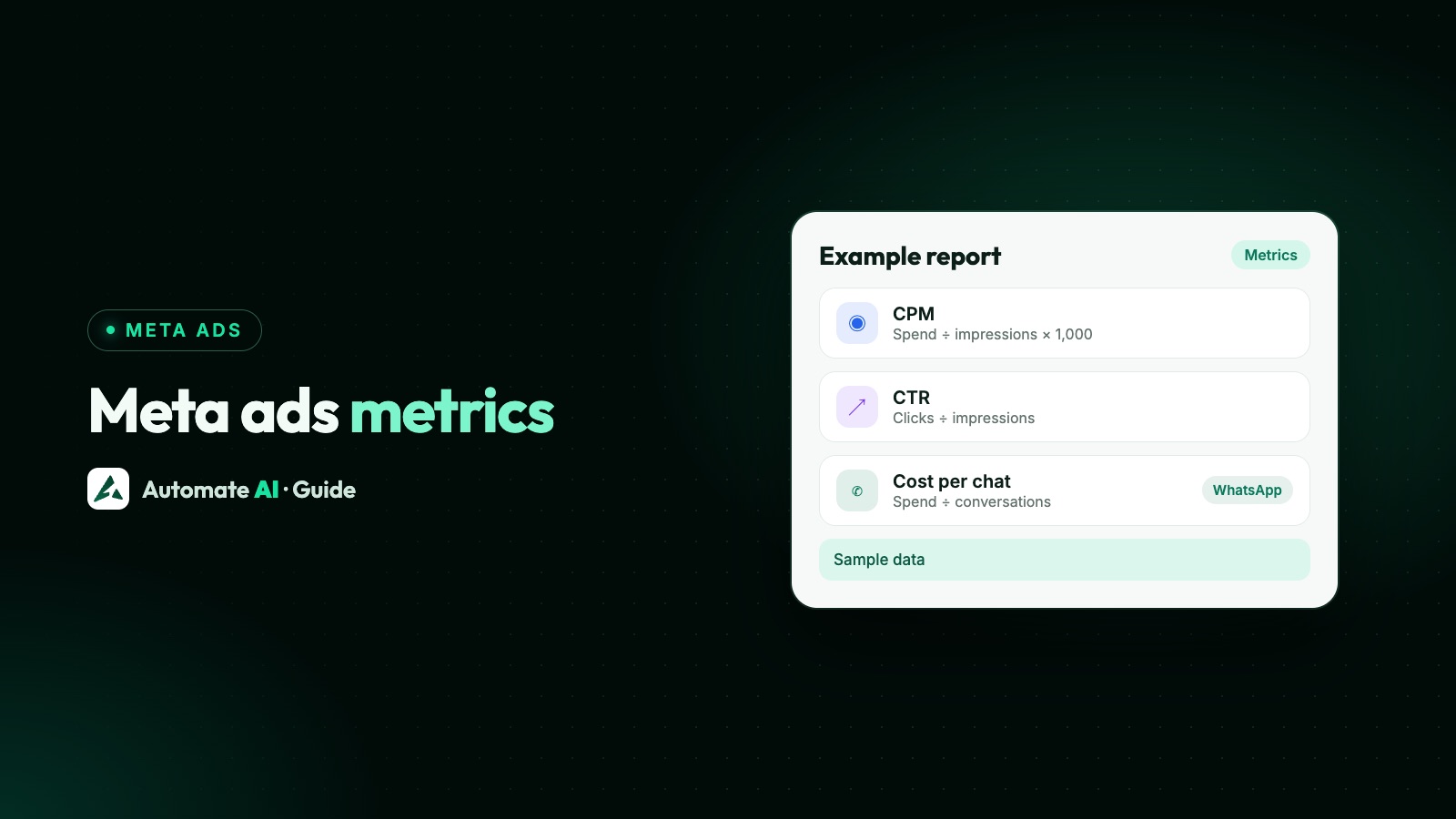
Meta Ads metrics are the numbers in Ads Manager that tell you what your ads cost and what they did: CPM is spend ÷ impressions × 1,000, CTR is clicks ÷ impressions, frequency is impressions ÷ reach, and ROAS is purchase value ÷ spend. Hook rate isn’t a Meta name; it usually means 3-second video plays ÷ impressions, and you can build it as a custom metric.
Below: each formula as Meta defines it, where to find it in Ads Manager, the messaging metrics for ads that open WhatsApp, a worked example and a reporting template.
Key takeaways
- Meta has two CTRs and two CPCs: the “all” versions count every click, including likes and comments, and the “link” versions count link clicks only.
- Frequency is impressions ÷ reach, the average number of times each person saw your ad. Watch it alongside results for signs of fatigue.
- Hook rate is a custom metric, usually 3-second video plays ÷ impressions. Meta’s own ThruPlay rate is ThruPlays ÷ 3-second views × 100.
- Purchase ROAS is purchase conversion value ÷ amount spent, so it only works when purchase values reach Meta.
- For WhatsApp ads, messaging conversations started counts people who messaged you for the first time or after 7 days of inactivity, from clicks on your ad.
Where the metrics sit in Ads Manager
Every metric in this guide is a column in the Ads Manager table. Choose a date range at the top right, then open Columns and pick a preset:
| Columns preset | What it shows | Covered below |
|---|---|---|
| Delivery | Reach, frequency, cost per 1,000 people reached | Reach and frequency |
| Video engagement | 3-second plays, ThruPlays, plays at 25% to 100% | Hook rate |
| Messaging engagement | Messaging conversations started and their cost | Messaging metrics |
To mix metrics from several presets, choose Customize columns. That’s also where you create custom metrics such as hook rate. Save the set as a preset so the whole team reads the same report.
Meta Ads metrics list with formulas
These are the formulas from Meta’s own glossary pages, in one place:
| Metric | Formula (as Meta defines it) | Tells you |
|---|---|---|
| Impressions | Times an ad is on screen for the first time | How often the ad was seen |
| Reach | People who saw the ad at least once (sampled data) | How many people saw it |
| Frequency | Impressions ÷ reach | Average views per person |
| CPM | Amount spent ÷ impressions × 1,000 | Cost of 1,000 impressions |
| CTR (all) | Clicks (all) ÷ impressions | Share of impressions with any click |
| CTR (link click-through rate) | Link clicks ÷ impressions | Share of impressions with a link click |
| CPC (cost per link click) | Amount spent ÷ link clicks | Cost of one link click |
| Cost per result | Amount spent ÷ results | Cost of the outcome you optimise for |
| Cost per messaging conversation started | Amount spent ÷ messaging conversations started | Cost of one new chat |
| Purchase ROAS | Purchase conversion value ÷ amount spent | Sales value for each unit spent |
| ThruPlay rate | ThruPlays ÷ 3-second views × 100 | How many viewers kept watching |
| Hook rate (custom) | 3-second video plays ÷ impressions, usually | How many people stopped scrolling |
Ads Manager shows CTR as a percentage. If you work it out yourself, multiply by 100.
Impressions, reach and frequency
Meta counts an impression each time an ad is on screen for the first time. Scroll past and back to the same ad and that’s still one impression; see it at two different times in a day and that’s two. A video doesn’t need to start playing for the impression to count, and Meta says it doesn’t count traffic it detects as invalid, such as bots.
Reach is the number of people who saw your ads at least once, and Meta calculates it from sampled data. Frequency is impressions divided by reach: the average number of times each person saw your ad.
Meta’s advice on frequency is to watch it alongside your results. If performance drops as frequency rises, your audience may be tired of the ad, and Meta suggests changing the creative or the targeting. In Ads Manager, the Delivery column can also show Creative fatigue when people have seen the same image or video too often.
What about a frequency cap?
A frequency cap is the most times one person will see your ad in a set time. In Meta’s glossary it belongs to reservation buying (fixed-cost campaigns, formerly called reach and frequency), where the default is 2 impressions every 7 days and you can change it. Most small-business ads use auction buying instead, where you manage frequency through audience size, budget and fresh creative.
CPM, CPC and CTR: the cost and click metrics
CPM is the amount spent divided by impressions, multiplied by 1,000. It tells you what it costs to be seen, before anyone clicks.
Clicks come in two kinds, and mixing them up is the most common reporting mistake:
- Clicks (all) counts many kinds of click, tap or swipe: link clicks, taps on your Page name or picture, reactions, comments, shares and taps to open a photo full screen.
- Link clicks count clicks on links to destinations, such as your website or a chat.
So CTR (all) is clicks (all) ÷ impressions and CTR (link click-through rate) is link clicks ÷ impressions. CPC (all) is the average cost of a click (all), and CPC (cost per link click) is amount spent ÷ link clicks. When you compare ads, compare the same version every time.
Cost per result is amount spent ÷ results, where a result is whatever your ad set optimises for. Meta notes it depends on your bid, audience, optimisation, creative and schedule, so compare it between your own ads rather than against someone else’s.
Hook rate: a common name, and how to build it
Hook rate isn’t a Meta name, but Meta’s glossary lists a metric called 3-second video plays rate per impressions; look for it under Customize columns first. Advertisers use hook rate for video ads to ask: of the people who saw the ad, how many watched long enough to notice it? The usual definition is 3-second video plays ÷ impressions × 100. Some people use video plays or 2-second continuous plays instead, so say which one you use when you share a report.
Meta does define the parts. A 3-second video play is counted when the video plays for 3 seconds, or for 97% of its length if it’s shorter, without counting replays. A ThruPlay is a play to completion or for at least 15 seconds. Meta’s own ThruPlay rate, ThruPlays ÷ 3-second views × 100, is close to what some advertisers call “hold rate”.
If that column isn’t in your account, build hook rate once and it appears like any other column:
- In Ads Manager, open Columns and choose Customize columns.
- Select Create custom metric.
- Build the formula: pick 3-second video plays, choose divide, then pick Impressions.
- Name it “Hook rate”, add a description of the formula and choose the percentage format.
- Choose who can see it. If you share it with everyone on the ad account, Meta says the formula can’t be edited or deleted afterwards, so check it first.
- Click Create metric and add it to your saved column preset.
Messaging metrics for ads that open WhatsApp
For Click-to-WhatsApp ads, the result that matters is a chat, and Meta has metrics for it under Columns › Messaging engagement:
| Metric | How Meta defines it |
|---|---|
| Messaging conversations started | Accounts that messaged your business for the first time or after 7 days of inactivity, attributed to your ads. For WhatsApp, only conversations started from clicks on your ad |
| Cost per messaging conversation started | Amount spent ÷ messaging conversations started |
| New messaging connections | People your business added as messaging connections, attributed to your ads |
| New blocked messaging connections | Times people blocked a messaging connection with your business, attributed to your ads |
Two cautions. Someone who messaged you in the past week doesn’t count as a new conversation, so a returning customer can tap the ad without adding to the number. And Meta says some messaging metrics aren’t available for ads delivered to and from Europe and Japan; its Click-to-WhatsApp guide adds South Korea.
A chat isn’t a sale. Cost per conversation tells you what a chat costs; whether the chats turn into customers depends on how fast and how well you reply. See how to get Meta Ads leads on WhatsApp.
ROAS and why chat sales need extra setup
Purchase ROAS is purchase conversion value ÷ amount spent. Spend ₹10,000 and record ₹40,000 of purchases, and ROAS is 4 (made-up numbers). Meta adds that it may use statistical modelling where events can’t be counted directly, and that ROAS may not be calculated in some cases, such as ads delivered to devices on iOS 14 and later.
ROAS only works when purchase values reach Meta. For website sales that’s the pixel or Conversions API. For sales that happen in a WhatsApp chat, Meta never sees them unless you send them back. Our guide on tracking which ads bring WhatsApp buyers explains how.
To know whether a ROAS is good enough, work out your break-even ROAS: 1 ÷ your gross margin. With a 40% margin you need a ROAS of 2.5 before the ads pay for themselves. The Meta Ads budget and ROAS calculator does this for you.
Which purchases count, and how long after a click or view, depends on the attribution setting. That deserves its own guide. For now, keep the same setting when you compare periods or ads.
A worked example and a reporting template
Here’s one video ad that opens WhatsApp, worked through with made-up example numbers. They aren’t averages or targets.
| Metric | Example figures | Result |
|---|---|---|
| Amount spent | ₹6,000 | |
| Impressions / reach | 120,000 / 40,000 | Frequency 3.0 |
| CPM | ₹6,000 ÷ 120,000 × 1,000 | ₹50 |
| CTR (all) | 2,400 clicks (all) ÷ 120,000 | 2% |
| CTR (link) | 1,200 link clicks ÷ 120,000 | 1% |
| CPC (cost per link click) | ₹6,000 ÷ 1,200 | ₹5 |
| Hook rate (custom) | 30,000 three-second plays ÷ 120,000 | 25% |
| ThruPlay rate | 9,000 ThruPlays ÷ 30,000 × 100 | 30% |
| Cost per conversation started | ₹6,000 ÷ 300 conversations | ₹20 |
| Purchase ROAS | ₹30,000 of purchases ÷ ₹6,000 | 5 |
Read it as a funnel: hook and ThruPlay rate judge the video, CTR and CPC the offer, cost per conversation the whole ad, and ROAS the sale. Where a number drops tells you what to fix.
A simple weekly reporting template, one row per ad: date range, amount spent, impressions, reach, frequency, CPM, CTR (link), hook rate (video ads), messaging conversations started, cost per conversation, purchases and ROAS. Add a notes column for what you changed that week, so a jump in cost can be traced to its cause.
Meta Ads metrics in Automate AI
If you run Click-to-WhatsApp ads from Meta Ads in Automate AI’s main menu, available on every plan for account owners and managers, you see Meta’s results for every ad in your connected ad account, including ones made in Ads Manager:
| In Automate AI | Meta’s metric |
|---|---|
| Spent | Amount spent |
| Views | Impressions |
| Reach | Reach |
| Clicks, CTR, Cost per click | Clicks (all), CTR (all), CPC (all) |
| Chats | Messaging conversations started |
| Cost per chat | Cost per messaging conversation started |
Pick a period from today to all time, sort ads by spend, chats or cost per chat, and open the contacts who messaged you from each ad. Frequency, hook rate and ROAS aren’t shown in the app, so read those in Ads Manager, where each campaign, ad set and ad is one click away.
To get ROAS for chat sales, the Conversions API integration can send Lead and Purchase events back to Meta for contacts who came from an ad, including a paid Shopify order with its value. Prefer forms? The Facebook Lead Ads integration saves each lead as a contact and can message them on WhatsApp straight away. If an ad isn’t spending at all, see Meta ads not delivering.
Frequently asked questions
What are the most important Meta Ads metrics?
The ones closest to your goal. For ads that open WhatsApp, that’s cost per messaging conversation started and, if you track sales, ROAS. CPM, CTR, frequency and hook rate help explain why those numbers move.
What does CPM mean in Meta ads?
Cost per 1,000 impressions: the amount spent divided by impressions, multiplied by 1,000.
What is the CTR formula for Meta ads?
CTR (all) is clicks (all) divided by impressions. CTR (link click-through rate) is link clicks divided by impressions. Ads Manager shows both as percentages.
How do you calculate hook rate for Meta ads?
Hook rate isn’t a Meta name. Most people use 3-second video plays divided by impressions, times 100. Meta’s glossary also lists “3-second video plays rate per impressions”; check Customize columns for it first, and if it isn’t there, build hook rate under Columns › Customize columns › Create custom metric.
What is the ROAS formula on Meta?
Purchase ROAS is purchase conversion value divided by amount spent. It needs purchase events with values sent to Meta, through the pixel or the Conversions API.
Can I set a frequency cap on Meta ads?
In Meta’s glossary, frequency caps belong to reservation buying, where the default is 2 impressions every 7 days. For auction campaigns, watch frequency next to your results and refresh the creative or widen the audience if performance drops.
What counts as a messaging conversation started?
Someone who messaged your business for the first time or after 7 days of inactivity, attributed to your ads. For WhatsApp, Meta counts only conversations started from clicks on the ad.
Sources
- Meta Business Help Centre: CPM (cost per 1,000 impressions)
- Meta Business Help Centre: CTR (all)
- Meta Business Help Centre: CTR (link click-through rate)
- Meta Business Help Centre: Frequency
- Meta Business Help Centre: Purchase ROAS (return on ad spend)
- Meta Business Help Centre: Messaging conversations started
- Meta Business Help Centre: About video ad metrics
- Meta Business Help Centre: Create custom metrics in Meta Ads Manager
WhatsApp rules and prices change. We check these guides against Meta’s documentation, but always confirm current terms with Meta before you rely on them. Questions? Message us on WhatsApp at +91 836 977 8812.