Meta Special Ad Categories: Housing, Jobs, Financial Products and Politics Explained
Meta’s special ad categories explained: what counts as housing, employment, financial or political ads, where they’re required and what changes in targeting.
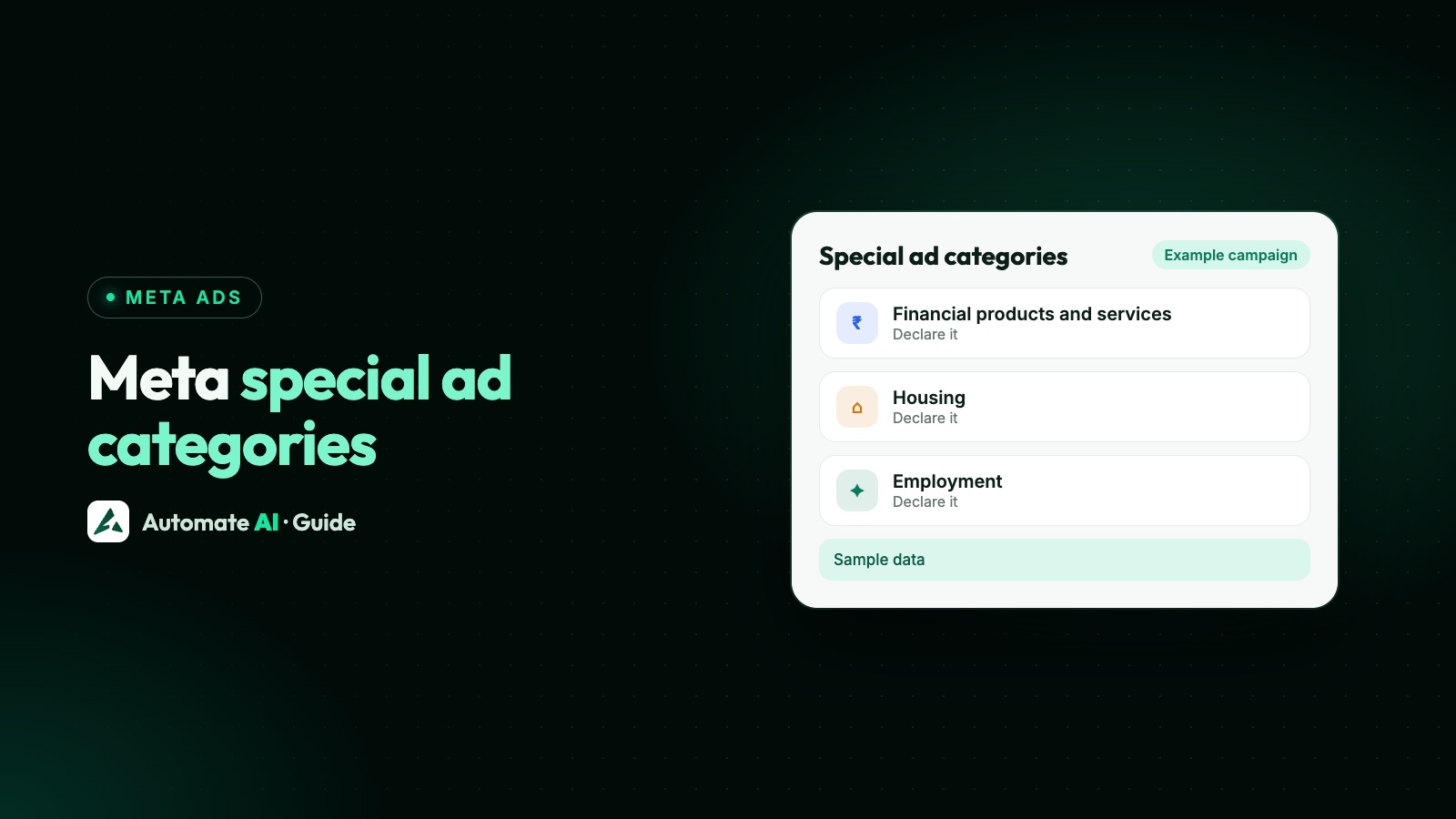
A special ad category is a label you must give a Meta campaign when its ads are about Financial products and services, Employment, Housing, or Social issues, elections or politics. For the first three, Meta limits targeting (age, gender, postcodes, lookalikes and more) to help prevent unlawful discrimination. For political and social issue ads, Meta requires authorisation and a “Paid for by” disclaimer instead.
This guide covers what each category includes, where you’re required to use it, what changes in your audience, how political ads differ, and how the category works in Automate AI’s Meta Ads menu. It reports Meta’s rules as Meta states them and isn’t legal advice; Meta also says its examples aren’t a complete list.
Key takeaways
- There are four categories. Financial products and services replaced the old Credit category in January 2025.
- Housing, employment and credit rules apply if you’re based in the US or reach the US, Canada or Meta’s listed European countries. The wider financial category is required for US advertisers or US audiences.
- With housing, employment or financial ads you lose age, gender, postcode targeting, exclusions, lookalikes and saved audiences, and city or pin areas get a bigger radius.
- Political and social issue ads need authorisation in each country, a “Paid for by” disclaimer, and stay in the Ad Library for seven years. They no longer run in the EU.
- Skip a category that applies and Meta may reject the ad; it says choosing one doesn’t change review time.
The four special ad categories
These are the names Ads Manager uses today, with Meta’s own examples:
| Category | What Meta says it covers |
|---|---|
| Financial products and services | Ads that promote or link to a financial offer, including credit: credit cards, loans (auto, mortgage, personal or business), long-term financing, debt recovery, consolidation and relief. In the US also banking, prepaid cards, investments, pensions, insurance, payment services and 0% APR instalments, including buy now, pay later |
| Employment | Part- or full-time jobs, internships, professional certification programmes, job boards and fairs, and ads about a company’s perks even without a specific job |
| Housing | Home or apartment sales and rentals, homeowners and mortgage insurance, mortgage loans, housing repairs, home equity and appraisal services |
| Social issues, elections or politics | Ads by, for or about candidates, political figures and parties, elections, referendums and get-out-the-vote campaigns, ads regulated as political, and ads about social issues such as health or civil and social rights |
Meta says the financial category doesn’t include gift cards, store rewards, business-to-business-only financial products, or tax and accounting services. Ads that only educate people about their rights under fair housing laws aren’t housing ads.
When you must choose one
Every campaign has to answer the question, but the duty to choose a category depends on the category and the countries involved:
| Category | Required when |
|---|---|
| Housing, Employment, credit offers | You’re based in the US, or your ads reach people in the US, Canada or certain parts of Europe |
| Financial products and services (beyond credit) | You’re based in the US, or your ads reach people in the US (since 21 January 2025) |
| Social issues, elections or politics | Your ads are about these topics, in countries where Meta requires authorisation |
Meta’s European list for credit ads includes the EU countries plus the UK, Switzerland, Norway, Iceland, Liechtenstein, Andorra, Monaco, San Marino, Vatican City, the Channel Islands, the Isle of Man and some overseas territories such as the Canary Islands, Madeira and Réunion. Check the current list on Meta’s page before you plan.
Meta’s developer documentation says businesses outside the US reaching people outside the US, Canada and Europe can opt in to the housing, employment and credit limits or answer “none”. So an Indian business advertising a home loan only in India isn’t required to use the category, but Meta’s ban on discriminatory targeting still applies everywhere. Financial ads may also need licence verification in some countries, India included; that’s covered in Facebook ads for insurance agents.
What changes in your targeting
For housing, employment and financial products and services, Meta applies these limits where the category is required (or when you opt in):
| Setting | With the category |
|---|---|
| Age | Generally fixed at 18 to 65+. Credit ads in Europe can use a different range to meet local rules |
| Gender | All genders; you can’t pick one |
| Location | No postcodes, neighbourhoods, metro areas or electoral districts, and no location exclusions |
| Radius | At least 15 miles (25 km) around a city, address or pin in the US and Canada; 15 km in Europe |
| Detailed targeting | No behaviour or demographic targeting, no exclusions, and only interests from Meta’s approved list |
| Lookalike and saved audiences | Not available; saved audiences are removed |
| Advantage+ catalogue ads | Same limits |
Meta says the limits don’t narrow your audience to people interested in jobs, homes or finance, and encourages you to broaden rather than restrict. In practice, your creative and your follow-up do the qualifying. A clear headline (“2BHK flats for rent in Andheri” or “Hiring delivery riders, Pune”) and a Click-to-WhatsApp ad where the first reply asks one or two questions sort people better than any targeting trick.
For property ads specifically, see Facebook ads for real estate leads. The general targeting options, before any category, are in Meta ads targeting.
Social issues, elections or politics: a different kind of rule
Political and social issue ads don’t lose age, gender or interest options because of the label, according to Meta’s developer documentation. But Meta’s help page on these ads says you can only target the country you’re authorised in (qualifying organisations such as NGOs can run social issue ads across markets once authorised in one country), and some placements may not be available. What changes is transparency:
- Authorisation. In select countries you must get authorised in the country where the ads will run: confirm your identity and give details of your organisation.
- A “Paid for by” disclaimer on every ad, linked to the Page and its ad accounts.
- The Ad Library. These ads are kept in Meta’s public Ad Library for seven years. See Meta Ad Library for how to search it.
- Whole campaigns. You mark the campaign, not single ads, and you can’t mix political and non-political ads in one campaign.
- The right roles. A Page admin links ad accounts and creates disclaimers; to create the ads you must also be an advertiser or admin on the linked ad account and have confirmed your identity.
If you don’t choose the category and Meta decides the campaign includes political or social issue ads, Meta says the campaign will be disapproved. Ads can also be disapproved if Meta’s signals suggest the person creating them is outside the country they target.
How to choose a category in Ads Manager
- Create a campaign, or open an existing one, in Meta Ads Manager.
- Select Special ad categories.
- Under Categories, choose the one (or more) that applies.
- Under Countries, choose where the campaign will run.
- Build the ad set. Meta limits the audience options to fit the category, so check the audience again before publishing.
Meta says choosing a category doesn’t change how long review takes. If an ad is rejected because a category was missing, fix the campaign and publish again, or request a review in Business Support Home if you think Meta got it wrong. More fixes are in Click-to-WhatsApp ad rejected.
In the US, Meta also suggests housing advertisers can add the Equal Housing Opportunity logo and slogan to show the ad isn’t discriminatory.
Special ad categories in Automate AI’s Meta Ads
When you make an ad in Meta Ads in Automate AI, the audience step asks “Is this ad about any of these?” with five answers. The AI that drafts your ad may already have picked one from your description, so check it.
| Option in Automate AI | Meta category it sets |
|---|---|
| None of these | None |
| Jobs | Employment |
| Housing or property | Housing |
| Loans, credit or insurance | Financial products and services |
| Politics or social issues | Social issues, elections or politics |
With any category chosen, the app shows the note “Meta requires these ads to reach all ages and genders, at least 25 km around a place, and no PIN codes, behaviours or exclusions”, and applies the age, gender, radius and PIN-code limits wherever you advertise, even in countries where Meta would let you opt out, and even for politics or social issue ads, where Meta itself doesn’t require them. Don’t add excluded places to these ads: the app still lets you, but Meta doesn’t allow location exclusions for these categories. It also won’t let you:
- add interests or lookalike audiences;
- show the ad in WhatsApp Status, which Meta doesn’t allow for these categories (the app checks this for ads made in Ads Manager too);
- open more than one chat app from the same ad, or make an Instagram profile ad.
Automate AI’s Meta Ads menu has no field for a country list or a “Paid for by” disclaimer, so set up political and social issue campaigns in Ads Manager after you’re authorised. More on WhatsApp Status rules in Meta ads placements, and on the builder itself in Click-to-WhatsApp ads.
Frequently asked questions
What are Meta’s special ad categories?
Financial products and services, Employment, Housing, and Social issues, elections or politics. You label a campaign with one when its ads are about that topic, and Meta then applies the matching rules.
Is the Credit special ad category gone?
Yes. Meta replaced it with Financial products and services, required since 21 January 2025 for US advertisers or US audiences. Credit is now a subset, and the credit rules for the US, Canada and Europe are unchanged.
Do I need a special ad category in India?
Not for housing, jobs or credit ads from an Indian business to people in India: Meta lets businesses outside the US, Canada and Europe opt in or answer none. Political ads and financial verification have their own rules.
Can I target by age with a special ad category?
Generally no. Housing, employment and financial ads are fixed at 18 to 65+ with all genders. Meta allows a different age range only for credit ads in Europe, to meet local rules.
What happens if I don’t choose a special ad category?
If one applies, Meta says the ad may be rejected. For political or social issue ads, the campaign will be disapproved if Meta finds they’re political and the category wasn’t chosen.
Can I run political ads from Automate AI?
The Meta Ads menu has a Politics or social issues option, but no field for the country or the “Paid for by” disclaimer, so get authorised and run those campaigns in Ads Manager.
Can job or housing ads show in WhatsApp Status?
No. Meta doesn’t allow special ad categories in WhatsApp Status, and Automate AI won’t offer Status for them.
Sources
- Meta Business Help Centre: How to choose a Special Ad Category
- Meta Business Help Centre: About ads for financial products and services
- Meta Business Help Centre: Roles and permissions for running ads about social issues, elections or politics
- Meta Business Help Centre: How to create ads about social issues, elections or politics
- Meta for Developers: Special Ad Categories
- Meta Transparency Center: Advertising Standards
WhatsApp rules and prices change. We check these guides against Meta’s documentation, but always confirm current terms with Meta before you rely on them. Questions? Message us on WhatsApp at +91 836 977 8812.